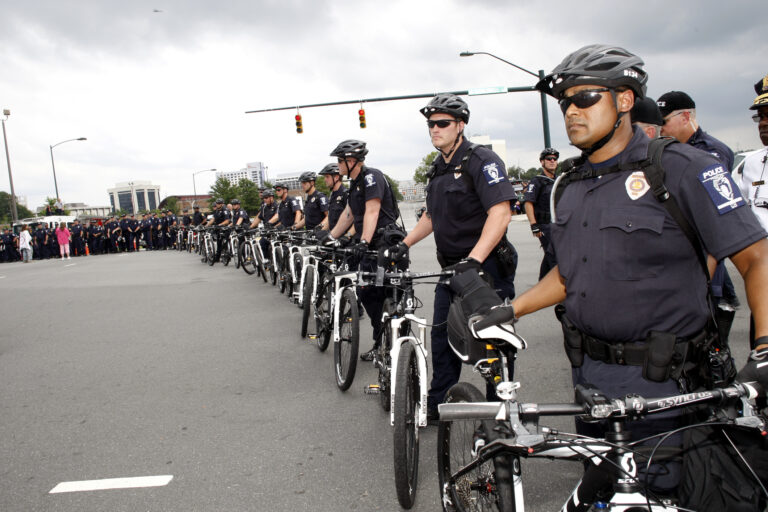



Today, you'll see the bicycle cop professionally and appropriately attired and operating some pretty sophisticated bicycles.
~ Barry M. Baker Tweet
The bicycle cop, open and unobstructed, has the potential to revive the lost intimacy the foot patrol officer once had with the community. Most major police departments had become fully motorized by the late 1960’s. That was a good thing for response time and efficiency, but something very important had been lost. The personal connection between the individual police officer and the community had been diminished.
In the mid 1970’s, the Baltimore Police Department purchased nine 10sp bicycles; one for each of its nine police districts. One bicycle cop from each district was chosen for a pilot program to assess the effectiveness of bicycles in the patrol function. Training consisted of each officer’s assurance that he could ride a bicycle. Accessories consisted of… well… nothing. There was no helmet or specially designed uniform. The pilot program provided the obvious conclusions.
The bicycle cop was mobile. He could move a lot faster expending less energy than an officer on foot. He could traverse over walkways and through narrow alleys where an automobile couldn’t go. However, there was one major problem. The 10sp bicycles of that time simply weren’t up to the task of surviving curbs and steps so frequently encountered in an urban environment. It would be another twenty years, before the bicycle cop would come of age in a meaningful way.
Today, you’ll see the bicycle cop professionally and appropriately attired and operating some pretty sophisticated bicycles. If you begin your police career patrolling a high crime urban area, you’ll frequently hear residents of that area calling for the return to police foot patrol. There are still a few people around who remember police officers walking beats. There’s no question that police officers walking beats is the most effective form of patrol. However, it’s far from the most efficient due to cost and geography. A single motorized officer can cover a far larger area of patrol than a foot officer.
One would think that the bicycle cop would be the perfect median between foot and motorized patrol. A bicycle cop has the mobility while possessing the same up close and personal aspect of the foot patrolman of yesteryear. While nearly every police department of any size will have a bicycle unit, few police commanders view bicycles as a significant tactical resource let alone a strategic one.
Even though bicycle cops are obviously part of a police department’s patrol resource, these bicycle units are rarely fully integrated into the patrol functions. You’ll learn that the biggest difference between you as a patrol officer and everybody else is that you’re the only one who routinely answers calls for service. When bicycle officers are deployed to routine patrol, the deployment is usually temporary, and its primary purpose is omnipresence.
Advertisements
An Insider's Guide to a Career in Law Enforcement by Barry M. Baker

Find schools and get information on the program that’s right for you.
Powered by Campus Explorer
CareerPoliceOfficer earns commission on qualifying purchases from these affiliate partners: