

Career
Police
Officer
Book Store
Ordering Page
for Becoming a
Police Officer
Motorcycle
Police
Motorcycle police units are another one of those units that bear the traditional
label which often places their continued existence into doubt.  When police chiefs
go through their periodic cost saving efforts, they'll often consider cutting back on
their motorcycle fleets to save dollars they can throw away on something else.  
Ironically, the single circumstance which will ensure the continued existence of
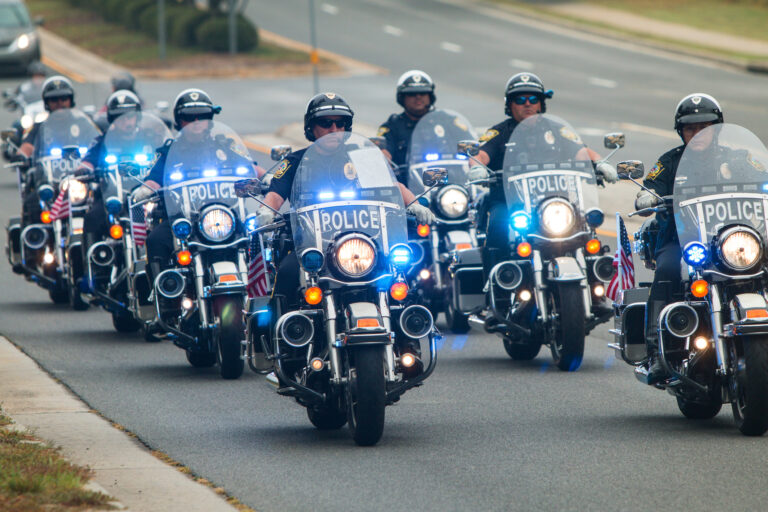
motor cops is the motorcade.  When the politicians want to impress other
politicians and
VIPs, they'll always turn to their police departments' motorcycle
police to provide impressive sound and light shows.

As a practical matter, the motorcycle police officer will always be a perfect fit for
traffic control and enforcement.  In case you haven't been on the road recently,
you'll find that motor traffic only increases.  Traffic jams have become a daily fact
of life in many parts of the country.  When situations exist that prevent normal
motorized patrol units from reaching a critical location in traffic due to
unexpected obstacles, the motorcycle officer will easily traverse around such
obstacles.

Another benefit derived from motorcycle police is image.  Sure...there will always
be those who think those helmets, boots, and well fitting uniforms project too
much authority...dah.  Even in police departments where there's little oversight
regarding the appearance of their uniformed police officers, their motorcycle
units won't suffer from that same lack of attention.  Motorcycle officers take
great pride in their appearance, and they always project a clean, professional
image.

If you're looking toward becoming a motor cop at some point in your career, you
should realize that there are risks involved.  More police officers die in
automobile accidents than in any other line of duty death.  The obvious problem
with a motorcycle is your very open exposure.  You face a higher probability of
injury from impact and ejection than you would from a car accident of similar
severity.

If you're already a motorcycle enthusiast, you should be familiar with the
absolute importance of safety considerations and your ability to develop the skills
necessary to keep unskilled and  inattentive drivers from hurting you.

Just because you may be an enthusiast in something will not necessarily make
you an expert.  When it comes to motorcycles, your police department will provide
you the training necessary to make your motorcycle assignment a safe and
rewarding experience.  As with any other type of training, you should never enter
training thinking you already know more than the trainers.  When it comes to
something like motorcycles, you may well have a high level of expertise when you
enter training; however, always remember that a training environment is
organized for training...not debate.


Since I'm no expert when it comes to the operation of motorcycles, I've searched
the Internet for those who are experts.  The article below describes some
excellent examples of how police training could sometimes differ from generally
accepted operational methods and the reasons for those differences.

I've also provided links at the bottom of the article to the author's website where
you'll find many more articles on motorcycle safety and other information.
 
"...despite the fact that full-face helmets are demonstrably
safer than 3/4 or smaller shells, there is not a single
motorcycle policeman in the entire country that wears
one."
~ James R. Davis
I have read that mounting a motorcycle from the right side is 'OK' and
for proof the poster pointed out that the motorcycle police in California
are required to do so.

While I believe it is true that at least the California Highway Patrol
requires their motorcycle officers to use the right side to both mount
and dismount their machines, that is hardly an example one should draw
heavy conclusions from. It may suggest that if you pull to the side of a
freeway and want to dismount you might be safer getting on and off on
the right side based on traffic risk, but that does not infer that it is
generally safer to do so.

Your side stand provides a WIDE tripod footprint (unlike your center
stand) that virtually guarantees your bike will not fall over if you lean
against it. (This, by the way, is why it is far safer to leave your bike on its
side stand than it is to put it on its center stand in a storm.) You would
court dumping the bike if it was not LEANING heavily on its side stand
when you mounted it (as when the bike is parked on a slope to the
right.) Similarly, mounting from the right tends to relieve pressure from
the side stand unless you 'hop' onto your left foot before your fanny hits
the seat. Worse, your right foot is planted firmly on the ground when
you do that and if the bike were to fall over you could not get away from
it.

This is not a challenge of the motorcycle police. But they are hardly the
best role models for most of us. Consider that despite the fact that
full-face helmets are demonstrably safer than 3/4 or smaller shells,
there is not a single motorcycle policeman in the entire country that
wears one. Also please observe that keeping two hands on the grips is
obviously safer than riding with only one in control. This is why those of
us with CB's have a PTT button within reach of a finger on the left hand
without removing that hand from the grip. Yet some of our motorcycle
police still use a hand microphone. (I'm told that in California - and
probably most everywhere else - most motorcycle police officers now
use helmet mounted microphones and conventional left-thumb
activated PTT switches - their helmet cords disconnect easily as they
leave their bikes.)

The answer to these apparently less safe practices of our motorcycle
officers is that they have different risks to manage than we street riders
do. They do not want to lose visual contact with a suspect for the brief
time it takes to remove a full-face helmet (nor do they want to occupy
both hands taking a helmet off.) They must often leave their bikes FAST
and a microphone/speaker cord going to their helmets could cost them
their lives if they had to deal with them at a vulnerable time. They tend
to work busy freeways and mount/dismount their bikes frequently at the
side of the road. (And, of course, they mount and dismount on the right
to put their bikes between themselves and a possible bullet from the
driver of the car in front of them.)

All I'm saying is that suggesting that a motorcycle officer be used as a
role model for how to behave on your street machine is a bad choice. It
is clearly safer (except, perhaps, on the side of a freeway) to mount and
dismount your bike from the left. It is safer to ride with a full-face helmet
than a smaller shell. It is safer to use a built-in microphone than a
hand-held.

But then again, it is safer not being a motorcycle officer in any event.
Copyright © 1992-2007 by The Master Strategy Group, all rights reserved.
www.msgroup.org
The Best Examples

By James R. Davis
Reprinted with permission
Tips & Techniques - Articles
Motorcops.com
Training articles
written by some of
the best motorcycle
police officers and
instructors along
with a listing of
Skills and Training
Competitions.
For almost two
decades,
Harley-Davidson
Motor
Company, Inc.
and the
Northwestern
University
Center for
Public Safety
have worked in
partnership to
present the nation's
premiere training
programs for police
motorcyclists.
Focusing on ten
practical exercises
that stress
low-speed
maneuverability,
evasion
techniques, and
high-speed braking
skills, students of
our program spend
approximately 90%
of the course "in
the saddle."
Motorcycle Accessories, Parts, and Apparel
ts
Google
Copyright © 2006 - 2008 - Barry M. Baker - CareerPoliceOfficer.com
Disclaimer
CareerPoliceOfficer.com is not responsible for the contents of any linked site or any link contained in a linked site,
or any changes or updates to such sites.   Links are provided only as a convenience, and the inclusion of any link
does not imply endorsement by this site.
Career Police Officer Affiliate Store
Shop a wide range of products and services
Police Exam Tips
Test Strategies
for
Police Applicants
CycleWorldNetwork
Social Networking
for Motorcyclists

brings people together
from all walks of life who
share a love for bikes
and riding. Registered
Members can swap trip
stories, bike pics, videos,
talk "shop", find ride
events and riding
buddies, and a whole lot
more.


As members contribute to
the Forums, submit
articles, and bring friends
along for the ride the
whole community benefits.

CycleWorldNetwork is
also working closely with
affiliates to bring special
benefits and discounts to
our Member community.