

Police
Marine
Patrol
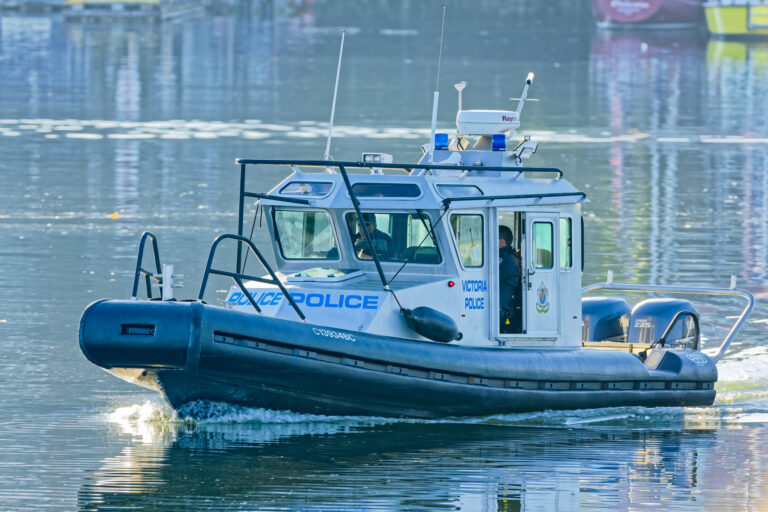
Tampa Police Marine Unit - The Marine Unit is made up of five
boats and two personal watercraft. The "flagship of the fleet" is a 32 foot
Donzi ZF boasting twin outboard engines providing 500 horsepower for
quick response and interdiction tasks. The Donzi is the cutting edge of
marine law enforcement with a gyro-stabilized camera system that is
designed for the marine environment. The camera has a triple sensor
(day/night/infra-red) system with broadcast quality. This system is capable
of real time down link broadcast to all district systems, the mobile command
post and a mobile response vehicle. The remainder of the fleet consists of
a 26-foot Boston Whaler, a 28-foot Goldline, a 19-foot rigid hull inflatable
and a 21-foot Carolina Skiff.
New Jersey State Police - Marine Services Bureau -
The Marine Services Bureau provides a full-time law enforcement service
for all of New Jersey's waterways and is the primary provider for all police
services on the water and contiguous land areas of the State of New
Jersey. The mission of the Marine Services Bureau is to protect and serve
the boating community and to preserve the natural resources of this state
by utilizing general law enforcement concepts, training and education, and
enforcing all laws fairly and without bias. We shall also provide a preventive
level of homeland security through intelligent, vigilant, and highly visible
patrol measures.
Philadelphia Police Marine Unit - The Philadelphia Police
Marine Unit has been in operation since April 9, 1859. Over the years the
Marine Unit has evolved and adapted to many different duties that it has
been delegated. In the 1950's, diving was added to the myriad of duties
that the Marine Unit handles. The unit has progressed from the
cumbersome "hard-hat" style of diving to a modern, lighter design with
reliable underwater communications.
Fort Lauderdale Police Marine Unit - Officers assigned to the
Marine Unit undergo a comprehensive 160-hour training program that
focuses upon boating operations. In addition to boating skills, a series of
written tests and practical operational skill examinations are administered
before an officer is allowed to operate a vessel. As part of our duties on the
water, we enforce waterway safety rules, respond to calls for service,
investigate burglaries and larcenies, and work in conjunction with other
entities involved with interdiction of illegal activities such as narcotics and
refugees. When you consider we have in excess of 100 miles of navigable
waterway which include the Atlantic Ocean, we patrol over two thirds of all
the waterways in Broward County. Coupled with the fact that there are
nearly 50,000 registered vessels in the Greater Fort Lauderdale Area, it is
realistic to comment that our assignment becomes complex.
The United States
Coast Guard (USCG)
is a military branch of
the United States
involved in maritime
law, mariner
assistance, and search
and rescue, among
other duties of coast
guards elsewhere.
One of the seven
uniformed services of
the United States, and
the smallest armed
service of the United
States, its stated
mission is to protect
the public, the
environment, and the
United States
economic and security
interests in any
maritime region in
which those interests
may be at risk,
including international
waters and America's
coasts, ports, and
inland waterways.
USCG has a broad
and important role in
homeland security, law
enforcement, search
and rescue, marine
environmental pollution
response, and the
maintenance of river,
intracoastal and
offshore aids to
navigation (ATON). It
also lays claim to being
the United States'
oldest continuous
seagoing service. The
United States Coast
Guard has about
40,150 men and
women on active duty.
With over 25,000 miles of navigable inland waterways in the United States, it
should come as no surprise that police departments maintain marine patrol units.
That number doesn't even include the thousands of miles of Atlantic, Pacific, and
Gulf coastlines that affect the police activities of coastal police jurisdictions. Prior
to 9-11, police marine units were tasked with obvious activities like enforcing
boating rules and regulations and conducting emergency water rescues.
9-11 has changed the picture for police marine
patrols and probably for the better. Aside from drug
smugglers, the vast majority of criminals with whom
police normally interact rarely use waterways as
their preferred mode of transportation. In the past,
a police department, responsible for a significant
body of water, maintained a marine unit more for an
emergency response capability rather than viewing it
as a significant contribution to its patrol activities.
The real threat of terrorism has exposed a very
large, and relatively un-patrolled, area of travel and
access to those who might desire to smuggle more
than drugs such as guns, bombs, and the people
willing to utilize them.
While the United States Coast Guard is, and will
continue to be, the premier defender of America's
coastlines and waterways, the need for more police
involvement in patrolling waterways should be
obvious. When one considers the growth in
population, the thousands of miles of shoreline, the
vast increase in commercial and recreational water
traffic, and the threat of terrorism, it should be
obvious to anyone that more marine patrol is the
only responsible course of action.
Assignment to a police marine unit is just like
assignment to any other specialized unit. You won't
be able to begin your career there. You'll have to
put the required amount of time in patrol, before
you can apply for transfer to your marine unit.
Don't forget to make those all important personal
connections with members of the unit. Without
those connections, your chances of getting the
assignment will remain mostly a figment of your
own imagination.
If you think that an assignment to a police marine unit would be a relatively easy
and carefree assignment, you're wrong. It's still police work with a few more
demanding and dangerous aspects added. While I think police boats are really
cool, I wouldn't want to be assigned to one. When I get into a bad situation, I
prefer to have solid ground beneath me, but that's just me.
Copyright © 2006 - 2008 - Barry M. Baker - CareerPoliceOfficer.com
|
CareerPoliceOfficer.com is not responsible for the contents of any linked site or any link contained in a linked site, or any changes or updates to such sites. Links are provided only as a convenience, and the inclusion of any link does not imply endorsement by this site.
|