

Copyright © 2006 - 2008 - Barry M. Baker - CareerPoliceOfficer.com
Disclaimer
CareerPoliceOfficer.com is not responsible for the contents of any linked site or any link contained in a linked site,
or any changes or updates to such sites.   Links are provided only as a convenience, and the inclusion of any link
does not imply endorsement by this site.
Civilian
Review
Board
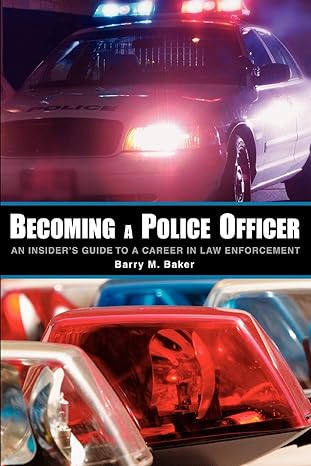
Ordering Page
for Becoming a
Police Officer
Google
Career
Police
Officer
Book Store
Civilian Review Board Websites
No matter what police department you join, there will be some form of a
civilian review board, or people will be talking about forming one.  The
political pressure for the formation of civilian review boards occur in
direct proportion to the size of a police department and the level of
crime.


If you join a small police department in a jurisdiction where crime is
under control and the law abiding population vastly outnumbers those
engaging in criminal conduct, civilian oversight will be informal and
effective.  In other words, when a police officer commits an egregious
act, the conduct will be obvious and unlikely to fall through the cracks.

When we move to larger centers of population where crime and
criminals exist in large numbers, the interaction between police and
criminals increases dramatically.  There are two factors that have a
great deal to do with how the public views that interaction.  First...where
ever the rate of crime is high, the public develops a higher level of
tolerance for crime and criminals.  Secondly, criminals don't exist in a
vacuum.  Like anyone, they have immediate and extended families, and
they have friends.  Politicians are the first to recognize that the families
and friends of criminals --when they exist in significant numbers --
represent a voting constituency...it's all about politics and power.


Think about this.  Every single police department in the United States
is, from its creation, under civilian control and review.  Notice that I put
control ahead of review.  Every TOP COP, referred to as Police Chief,
Police Commissioner, or Superintendent is a political appointee
appointed by an
elected politician (governor, mayor or city manager), and
the appointment is usually confirmed by a group of
elected politicians
serving in a state legislature, or in city, county, or town councils.

Since every police department is already under civilian control, where is
the need for an additional layer of bureaucracy consisting of 7 to 9
additional political appointees as recommended by the ACLU?  Under
the
ACLU's Effective Model, a civilian review board should have total or
near total control over every function of a police department.

It's probably just me, but I have to ask the question..."Why would
elected officials cede their responsibilities of control, oversight, and
review to a group of unelected people who will, without doubt, use their
positions to promote their own political and social agendas?  
Fortunately, most governments do not cede that ever sought after total
control by organizations like the ACLU.  The ACLU suggests that, "The
seven to nine CRB members are representatives of community
organizations (ie - ACLU, NAACP, etc.) ..."  I'd be curious to know
those organizations described by etc., but I get the drift.  In fairness,
the ACLU does infer their desire to avoid controversy with this
statement, "Having current or former police officers on the CRB can be
controversial."  Well...so much for fairness.

Now...I'm a reasonable person, and I have quite a bit of experience when
it comes to the politics of disciplinary matters within a police
department.  I'd be the first to agree, even with the ACLU, that many
police departments, particularly the larger ones, do a pretty lousy job in
conducting internal investigations.  It's pretty lousy when an internal
investigation concludes with more questions than answers, or an
investigation just languishes; until, time limits make it irrelevant, or
interest in the investigation just fades away.

Excluding investigations of criminal conduct, internal investigations
should be the easiest investigations for police investigators to conduct.  
First, only a preponderance of evidence is necessary to sustain a
complaint of misconduct against a police officer.  Secondly, a police
department's rules and regulations are usually comprehensive, and if
something is missed, there's always a "catch all" charge to nail you.

You're entering a career where you'll be continuously subjected to the
possibility of disciplinary action.  I can't think of any other profession or
occupation that presents so much risk involving so many varied
situations and circumstances.  While some police departments take the
subject of discipline very seriously, others don't...at least when it comes
to certain people.  That's why it's very important for you to give the
police department you intend to join the same level of scrutiny that it's
going to put on hiring you.


It's all about the police chief, commissioner, superentenant...the TOP
COP.  I'll use mayor and police chief to make this point.  If a mayor
appoints a police chief who is a strong and experienced administrator,
there won't be a lot of disciplinary problems within that police
department.

Guess what?  A police chief doesn't even have to be a police officer.  It's
okay if the chief is, or has been, a police officer as long as the chief
possesses those all important administrative skills.  You may ask, "If
the police chief doesn't have a police background, how can the chief
understand the job?  Remember...the police chief is a political appointee
whose only job is to command a thoroughly efficient and professional
organization.  When it comes to understanding the police work aspect of
the organization, the chief's command staff can fulfill that need.

The administratively strong chief will choose a command staff whose
members are also administratively strong, and they'll be (hopefully)
experienced police officers as well.  I put "hopefully" in there, because
high ranking positions within police departments are frequently
susceptible to political considerations if not outright political pressure.  
However, if the mayor is willing to use his or her political muscle to
shield the chief from political interference, this chief will be well on his
or her way to establishing, and maintaining, a thoroughly efficient and
professional organization.


I have no problem with a quasi-governmental civilian review board to
monitor police conduct.  I have no problem with a process that allows
recommendations for further review or change.  However, that process,
itself, must be closely monitored by the elected politicians who create
the process, and those same elected politicians must be held responsible
for the actions of their creation.  When you see a Civilian Review Board
with the authority to independently impose its will, you'll also see a
bunch of elected politicians running from the heat of controversial
issues.

No police department, no matter how efficiently and professionally it's
operated, will be totally free from the ravages of political influence...it's
just a matter of degree.  There's nothing you can do about it except to
stay far, far away from those police departments that have fallen under
the total, or near total, control of a Civilian Review Board.
...it's all about politics and power
...an additional layer of bureaucracy
The Civilian "Review" Board
...the TOP COP
Steven Greenhut
Columnist and senior
editorial writer
Civilian review:
guard for the
guardians
Rough justice
Rough justice, Part II
Secrecy shrouds
cops' rough justice
Police rush to shoot,
but ask us to
withhold judgment
Police can't police
themselves
View all of Steven's
Op/Eds here
Steven Greenhut is a senior
editorial writer and columnist
for the Orange County
Register and blogger for
blog.ocregister.com/orangepu
nch. He joined the Register's
editorial page staff in 1998,
after serving as editorial page
editor of The Lima News, a
daily in northwest Ohio. Both
newspapers are owned by
Irvine-based Freedom
Communications.

He is author of the 2004 book,
Abuse of Power: How the
Government Misuses Eminent
Domain
. He has written for
political magazines including
the Freeman, the American Conservative and Chronicles.

Greenhut won the Institute for Justice’s Thomas Paine Award
for his writing promoting freedom, an award previously won
by ABC’s John Stossel, the Wall Street Journal’s John Fund
and the Boston Globe’s Jeff Jacoby. In 2004, he was the
Visiting Journalist at the Property and Environment Research
Center (PERC) in Bozeman, Mont. He is a regular guest on
KPCC’s Air Talk program in Southern California, and appears
on local TV shows and regularly speaks to civic, academic
and political groups. He recently wrote a booklet analyzing
Proposition 90 for the Pacific Research Institute. He has
given speeches all over the country on property rights,
including at the Massachusetts School of Law and the
Preserving the American Dream conference in Atlanta.

Before joining the Lima News in 1995, Steve held a variety of
writing positions, including as building and remodeling editor
at Better Homes and Gardens magazine in Des Moines, Iowa.
He graduated from George Washington University in 1982.
He is married and has three daughters.
Recommended Reading
It's not that often when I find a columnist who can be critical
of police officers without boring me to tears after the first
couple of paragraphs.  Not so here.  Perhaps it's because I
agree with Mr. Greenhut's basic philosophy regarding
government.  Perhaps it's his ability to criticise without
sounding judgemental, or...perhaps it's because I can relate to
some of the situations and circumstances he discusses.  What
ever my reasons may be, I find his writing thoughtful and
thought provoking and food for thought for anyone aspiring to
become a police officer.
Police Exam Tips
Test Strategies
for
Police Applicants
Online Video Learning Systems:   Police Exam   -   U.S. Border Patrol Exam