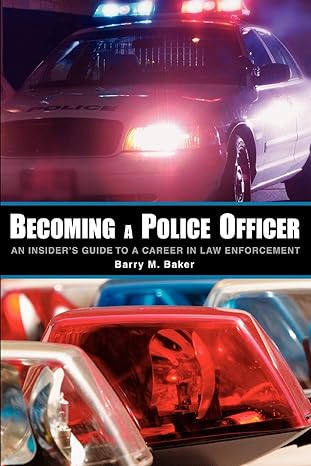

You should also realize that the police disciplinary process in many police departments is corrupt, misused and arbitrary.
~ Barry M. Baker Tweet

Detective Lieutenant Barry M. Baker (ret.) is a 32 year veteran of the Baltimore Police Department.

Police disciplinary process is a term implying a standard method to investigate and adjudicates police misconduct; don’t take it literally. As you ponder your decision to become a police officer, you should understand a few things. You’ll be frequently exposed to circumstances that could result in some kind of disciplinary action being taken against you. You should also realize that the police disciplinary process in many police departments is corrupt, misused and arbitrary.
One of the worst things a police officer can do is form conclusions based on initial information. Even your initial eyeball observation of a particular situation or incident may not tell the whole story. Since things are frequently not the way as they first appear, this is good advice.
You’d think that most police officers have this acquired skill down pat. Well… maybe not most, but many don’t. If you ever find yourself as the accused, you’ll be surrounded by police jumping to conclusions all over the place. This isn’t a rare phenomenon, because police have always been their own most severe critics… not of themselves, but of each other.
Facts versus Stupidity – Prejudice – Incompetence
You’ve got to train yourself to put facts ahead of everything else… not just facts you like, but all the facts. As long as you chase facts and only facts, you’ll never go wrong.
Unfortunately, you could find your actions being investigated by people who have a difficult time with facts. These people tend to recognize only facts that fit with a preconceived conclusion. They’ll simply ignore facts that depart from the preconceived conclusion.
An investigation corrupted by stupidity, prejudice, and incompetence occurred involving two female police officers under my supervision.
The first officer responded to a call for a suspect armed with a gun. She observed a suspect fitting the description, and a foot chase ensued. Moments later, the second female officer was assigned to a second, unrelated, emergency call in the same general area.
The first officer lost sight of the armed suspect. She was returning to her vehicle, and she observed the second officer responding to her call. The second officer had her emergency lights activated, and she attempted to pass a vehicle which she believed had yielded the right of way. However, as she attempted to pass, the vehicle moved back, and a collision occurred. Both cars were moving at slow speeds resulting in minimal property damage and no physical injuries.
Not a Complicated Case for the Police Disciplinary Process
I responded to the scene where I quickly collected all the facts pertaining to the circumstances of both incidents. Both officers explained that the civilian vehicle did appear, by its movement, to yield to the police vehicle. The department classified departmental vehicle accidents into two categories… preventable and non-preventable. I gave the bad news to both officers that this accident would undoubtedly be determined “preventable.” Both officers simply nodded as if to say, “Yea, we know.”
Since a departmental vehicle was involved, the accident would be investigated by an “expert.” A member of the department’s Traffic Investigation Section responded. I told the investigator I would be available if he needed to clarify any information. The investigator replied, “Thanks, Sarge… I got it.” I left the scene shortly thereafter since it appeared I wasn’t needed. After all, it wasn’t a complicated investigation.
Some Real Nonsense
Two weeks passed, and the official notification of disciplinary action arrived for the female officer involved in the accident. The accident was determined to be preventable with the standard disciplinary action for an accident of its type. As I reviewed that packet, I came to the “Investigator’s Summary.” I’d seen some awful police reports, but this load of nonsense was one of the worst I’d ever seen.
The full single page summary barely addressed any details of the accident. It went into extensive detail describing why the witnessing officer’s account was “not credible.” The investigator explained that the witnessing officer was engaged in a foot chase of an armed suspect, Therefore, she would have had to stop and turn around at a precise instant in order to witness the accident. The investigator had the sources to establish the facts of the two unrelated incidents, but he chose not to use those sources.
I learned the investigator never interviewed the officer involved in the accident. He made only one comment to her, “I figured it would be a woman.”
The only interviews he conducted were with the operator and occupant of the civilian vehicle. As far as the witnessing officer was concerned, he showed absolutely no interest in her observation of the accident.
The investigator had obviously drawn his conclusions on two circumstances. First, the operator of the police vehicle was a woman. Secondly, he thought she was responding to back up the witnessing officer who was chasing an armed suspect; hence, his ridiculous assassination of the witnessing officer’s credibility.
A Big Black Hole Hides Within the Police Disciplinary Process
You’ll learn that every police department has a means to deal with those who are tasked with applying the police disciplinary process when they are themselves caught in wrongdoing. It’s a big black hole that sucks in all the facts, so those facts will never again see the light of day.
My subsequent report detailing all the facts and exposing the bias and gross incompetence displayed by the investigator was quickly sucked into that hole. The good thing about black holes is that they suck in everything. Along with my report, the disciplinary action against my officer disappeared, and neither would be seen or spoken of again.
However, this story doesn’t end here. Several months later, the witnessing officer in the investigation was, herself, involved in a minor departmental traffic accident. Can you guess who was assigned to investigate the accident? This time, however, the investigator comported himself as a true professional.
His polite and respectful demeanor toward the officer repaired the previous damage; even though, no words were exchanged regarding the previous debacle. The investigator’s subsequent finding of “non-preventable” helped as well.
Presumption of Innocence - Reasonable Doubt
I know you’re already familiar with the terms presumption of innocence and reasonable doubt associated with the criminal justice system. When it comes to an administrative police disciplinary process, no such pretenses exist. If you become a target of your department’s police disciplinary process, you’ll be faced with a presumption of guilt and a preponderance of evidence.
While the presumption of guilt is easy to understand, the preponderance of evidence is a difficult concept for some. Preponderance of evidence simply means that only the barest amount of evidence needs to be developed to indicate that you’re probably guilty of the allegation against you.
Preponderance of Evidence Rules the Police Disciplinary Process
The preponderance of evidence standard is not a bad thing. As long as evidence is not contrived or fabricated, it’s an efficient and sensible way to maintain a high level of discipline within a police department. If your police department demands a high level of integrity from everyone, including those administering the police disciplinary process, you’ll find yourself exposed to a structured and relatively problem free disciplinary environment.
On the other hand… you could find yourself working in a police department where the corrupt and arbitrary administration of the police disciplinary process can create a very unpleasant working environment. The police disciplinary process of every police department is subject to the negative influences of politics and favoritism, and some are worse than others.
The best way to avoid becoming a victim of your department’s police disciplinary process is to follow the rules. You could experience disciplinary actions for minor violations by virtue of your imperfect nature as a human being. The more serious, and career threatening, violations can be easily avoided.
You could find yourself working in a police department where the police disciplinary process is continually compromised for the benefit of some to the detriment of others. You’ll just have to be careful and always prepared to logically and coherently articulate your actions for everything you do.
Related Content for Police Disciplinary Process
Advertisements