As a foot patrol officer, you'll be explaining actions of other police officers to neighborhood residents on a continual basis.”
~ Barry M. Baker Tweet

Detective Lieutenant Barry M. Baker (ret.) is a 32 year veteran of the Baltimore Police Department.

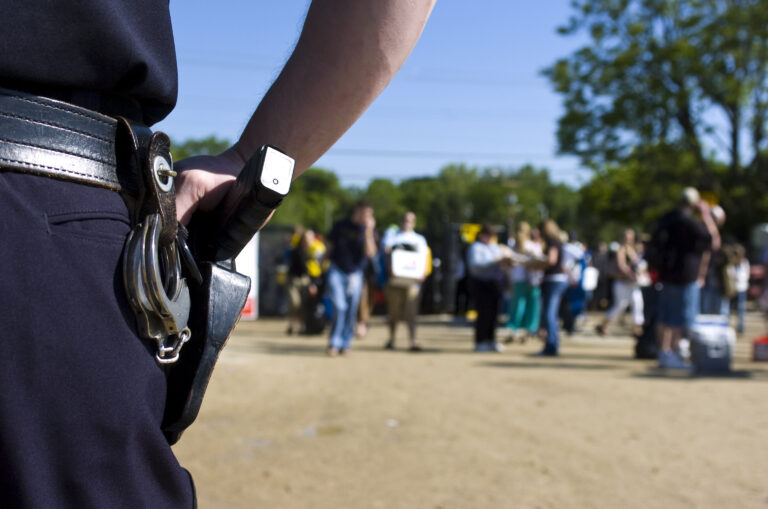
Police foot patrol is, without any doubt, the most effective form of preventative or pro-active police patrol in a densely populated setting. The uniformed police foot patrol officer is both highly visible as well as invisible. The uniformed police foot patrol officer is the most effective response to any discussion about community policing.
When and where is Police Foot Patrol Most Effective?
It’s all about crime numbers and population density. An urban environment experiencing high crime numbers is obviously the first choice for effective police foot patrol. There was a time when every urban setting in the country was patrolled by foot officers.
There were just a few motorized officers to support the foot officers with back-up and prisoner transport. The police foot patrol officers, in those days, didn’t even have radio communication. Times and circumstances change, and there came a time when foot patrol officers neared extinction in most urban population centers.
When I started my police career in 1971, Baltimore had become a fully motorized police department. The department was well manned and equipped. The response time to any call was under two minutes once the motorized officer received the call via radio. Baltimore, however, did maintain a number of police foot patrol posts/beats in commercial areas of the city.
Additionally, Federal Grant money was devoted to maintain of a number of foot posts in high crime residential areas. During the first seven years of my career, I was assigned to three of those residential posts in East Baltimore.
Baltimore’s transition to a motorized police department was efficient, but those police foot patrol posts proved valuable throughout their existence. The pin maps told the story by the number of pins denoting the occurrence of Part I crimes. During the days and hours those foot posts were manned, crime was practically non-existent. The absence of crime was no surprise to anyone, because everyone knew the effectiveness of well supervised police foot patrol.
Who wants to be a Foot Patrol Officer?
Nobody. Perhaps that’s an exaggeration, but it’s not too far off. You’ll want to get a police car, because you’ve been conditioned to view police officers with police cars. New police officers like the idea of riding around in police cars with red and blue lights and sirens. I wasn’t any different, and I was disappointed when I didn’t get that car right out of the police academy.
It didn’t take me long, however, to realize what a good deal I had with a foot patrol assignment. I wasn’t burdened with being assigned calls for service, and I could handle any call I wanted to handle. I’d often take calls from others when I knew the incidents were interesting and worthy of additional investigation.
East Baltimore was a veritable laboratory for criminal investigation. The foot patrol assignments afforded me the time to investigate and solve all type of crimes. I didn’t have to spend seven years on those foot post assignments, but I was having the time of my life and learning so much along the way.
The Ultimate Form of Community Policing
When you become a police officer, you’ll observe, or be involved in, all kinds of schemes labeled as Community Policing. I call them schemes, because that’s simply what they are. Some may have police foot patrol as an element, but any foot patrol is usually sporadic and poorly supervised. There is little to no emphasis placed on actual law enforcement activities.
Many community policing advocates forget that a police officer is first a law enforcer, and everything else comes afterward. When community policing experts form their latest scheme, the law enforcement part is viewed as an unavoidable annoyance.
When a police officer is assigned to a foot post on a continuous basis, real community policing can be realized. As a foot officer, you’ll be up close and personal with every element of the community. You’ll soon become a walking encyclopedia of who’s who in the neighborhood.
What are the Benefits for the Police Officer?
There’s nothing better than a foot patrol assignment for a new police officer. You’ll be alone, and you’ll be out in the open without the protective shell of the police car. The lack of means for a quick get-a-way will prevent you from developing a hit-and-run mentality.
Imagine yourself as a foot officer in the midst of a neighborhood dispute that’s developed into a street disturbance. It’s gone a little beyond your ability to control, and you call for help. Police cars roll into the block, and the disturbance is quickly abated by the presence of additional police officers.
The response alone worked, but a couple of officers can’t resist making comments that would better been left as thoughts. The officers get into their cars, and they leave you to abate the new anger created by the officers’ comments.
It’s not a big deal. As a foot patrol officer, you’ll be explaining actions of other police officers to neighborhood residents on a continual basis. Most complaints will be about how an officer talked to the person and how the communication was perceived. For example, was the officer’s comments perceived as rude, sarcastic or indifferent?
Your availability and willingness to listen and explain will, in almost every instance, take the sting out of the person’s embarrassment. Further, that willingness will solidify your image as a fair and impartial arbiter.
Why isn't Foot Patrol Implemented on a Large Scale?
Cost is always cited as the major impediment to putting police officers on foot patrol, and it is a valid reason. However, many police departments, particularly larger ones, spend a lot of money and expend a lot of manpower on the new idea of the moment. Let’s face it. Foot patrol is a tried and true form of policing; however, it’s “old school,” and it doesn’t fit into the new police culture of hyper-innovation.
Related Content for Police Foot Patrol
Advertisements