
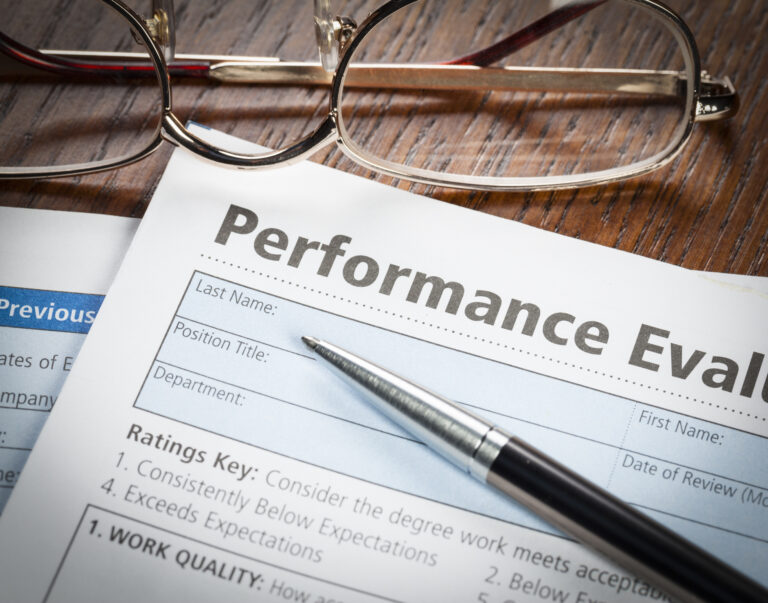
The only real importance of the performance evaluation report lies in addressing unsatisfactory performance.
~ Barry M. Baker Tweet

Detective Lieutenant Barry M. Baker (ret.) is a 32 year veteran of the Baltimore Police Department.

Police performance evaluation is a process that will accompany you from the police academy to the very end of your police career. Your work performance will be evaluated through some form of written evaluation procedure. Police departments begin that evaluation of your work performance during your academy training with a Field Training Officer program.
Let’s say your academy training is six months in duration. During the second half of that time, you may be assigned to an FTO (Field Training Officer). This training will be actual police work where you’ll perform as a fully functional police officer. Here’s where you’ll first become familiar with police performance evaluation reports.
Some police departments will do a better job of creating standards for their police performance evaluation reports than others. However, no matter how objective performance evaluations are purported to be, it comes down to one individual rating another individual.
The Police Performance Evaluation Report Can End Your Police Career
Early in my career a young officer approached me seeking advice. The officer was in his first year probationary period, and he received an unsatisfactory quarterly police performance evaluation from his sergeant. A second consecutive unsatisfactory evaluation would mean termination, so he was obviously concerned.
While I didn’t work with the officer, I’d never heard anyone speak negatively about him. His sergeant, on the other hand, was a different story. The sergeant had, on several occasions, asked me to transfer to his squad. I wasn’t about to accept the invitation, because I personally viewed the sergeant as a sadist.
That sergeant’s regard for me ended abruptly one day after I became involved in a deadly force situation. I would have been justified in shooting a suspect, but events happened rapidly. I ended up apprehending the suspect without using deadly force. After learning the details of my incident, the sergeant promptly confronted me.
Dis-invited
With a plethora of insulting comments, he dis-invited me from joining his squad. I made notes documenting the sergeant’s rude and sadistic comments, and I tucked them away just in case. Sometime in the future, someone might try to put me under that sergeant’s supervision. In contrast, my sergeant was extremely pleased with my conduct, and his opinion was the one that counted.
Back to that young officer. I advised him to seek a meeting with his lieutenant through channels and ask to be supervised by another sergeant until his next evaluation. He followed my advice, but his lieutenant denied the request. The officer received his next evaluation from the same sergeant, and not surprisingly he received the second unsatisfactory evaluation.
It was the second consecutive unsatisfactory police performance evaluation, and his employment was terminated. I don’t know what ever happened to that officer. If he did apply to another police agency, those unsatisfactory evaluations would dim his prospects for employment.
Satisfactory or Unsatisfactory Would be a Simple Criteria for Maintaining Objectivity
It would be nice if a truly objective police performance evaluation report existed. I’d get arguments from people who contend they do exist, but those arguments would be based on subjective opinions. Wherever a person’s objectivity is a primary factor for any procedure, the objectivity of that procedure becomes questionable.
The only real importance of the police performance evaluation report lies in addressing unsatisfactory performance.
If the goal is truly objectivity, there should only be two categories for performance… satisfactory and unsatisfactory. Unsatisfactory should be easy to establish. Verifiable facts of circumstances should exist to articulate the basis for a rating of unsatisfactory performance. When negative facts are absent, the satisfactory rating leaves no room for subjective opinion.
There’s nothing simple in life or police work. It’s likely that your police performance evaluation report will have some complexity. A written directive should exist to describe how to interpret and apply different categories. The more categories that exist to rate performance will dictate the variations in interpretation and application exercised by individual raters.
As should be expected, your police performance evaluation will enjoy a fairly high level of confidentiality. The subject material should have restricted access for a variety of reasons. Can you imagine the displeasure and pure dissension that would be created within your squad if everyone could compare their police performance evaluations?
Little if any Career Impact for Most
Your police performance evaluations will have little, if any, impact as long as you remain satisfactory or above. You could work for a supervisor who never supervised anyone he or she believes excels beyond satisfactory or average. Most of the time, supervisors who consistently rate people as average are themselves recipients of average evaluations.
You might ask that since police performance evaluations are unreliable, why have them at all? It’s simply a matter of discipline and control. For any supervisor who takes the performance evaluation seriously, it can be a valuable tool for addressing your deficiencies as well as recognizing your strengths.
Even though you’ll be a prejudiced reviewer of your own evaluation, it can be a benefit to you. As long as your supervisor makes the effort to fairly, objectively, and accurately rate your performance, you’ll recognize that your supervisor has a pretty good understanding of your strengths and weaknesses. When this circumstance exists, the performance evaluation can have a positive effect on your personal development.
Related Content for Police Performance Evaluation
Advertisements