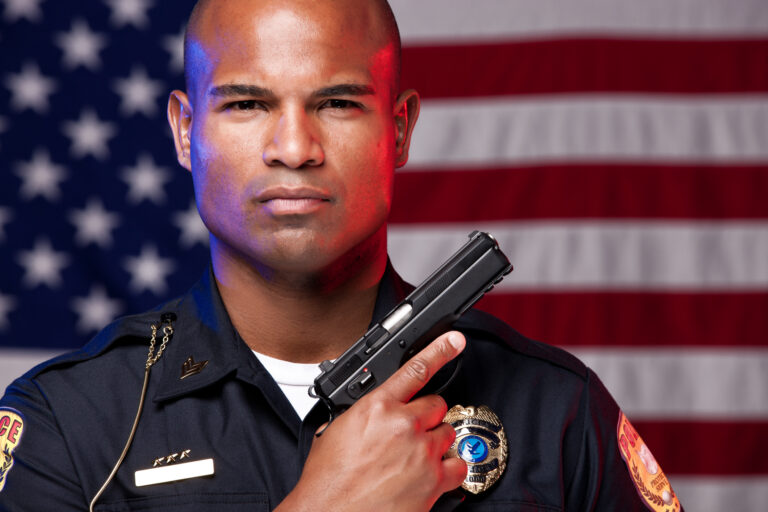
Aside from the deterrent effect a police officer's service pistol may or may not project, the only purpose for the handgun is the application of deadly force.
~ Barry M. Baker Tweet

Detective Lieutenant Barry M. Baker (ret.) is a 32 year veteran of the Baltimore Police Department.

Police service pistol is best defined as a magazine fed semi-automatic handgun issued to police sworn personnel as an officer’s primary weapon. As a police officer and a first responder, you already know that you’ll be required to possess and use a multitude of skills and knowledge associated with other professions. The one thing those other professional practitioners do not include in their tools of the trade is a handgun.
Aside from the deterrent effect a police officer’s service pistol may or may not project, the only purpose for the handgun is the application of deadly force. You don’t have to be a gun lover to appreciate the fact that the police service pistol is an indispensable tool for a police officer. It doesn’t matter whether or not you ever have to apply deadly force in the line of duty.
If you’re lucky, you’ll never have to apply deadly force, but you must remain proficient with your police service pistol from the beginning to the end of your career. Even in police departments consumed with the “thinking out of the box” mania, they don’t monkey around with firearms training. You’ll find firearms training to be the most structured and no nonsense training you receive.
The Revolver - Used to be the Standard Police Service Weapon
Prior to 1990 the vast majority of police departments issued revolvers as the primary service weapon. Colt and Smith & Wesson had the lion’s share of the police market. These weapons were excellent in their operation and dependability. Over the years, improvements in ammunition; speed loading devices, and safety holster technology only enhanced their suitability for police work.
The most ideal feature of the revolver was its double action. All you had to do was pull the trigger, and the cylinder would rotate a live round for firing. At the same time, the hammer retracted before falling forward causing the firing pin to strike the round. The double action weight of the trigger pull prevented you from accidentally discharging the weapon.
The Semi-Automatic Pistol
The semi-automatic pistol has been around for a long time. During the heyday of the revolver, few police departments issued magazine fed semi-automatic pistols. The ammunition capacity of the semi-autos was not more or that much more than the six shot revolver. The semi-autos had to be cocked before firing or a safety device would have to be released before firing. Additionally, the trigger pull was much lighter than the double action revolver increasing the possibility for an accidental discharge. Further, semi-autos were prone to jamming if a shell casing was not fully ejected.
My Smith & Wesson revolver served me well for twenty years, before the department changed over to the Glock 17. The first time I fired the Glock 17 9mm, I fell in love with it. The Glock police service pistol was easier to keep on target after recoil, and the speed of reloading surpassed a revolver. The department would eventually move on to the Glock 40mm, and the love affair continued.
Like the revolver, you can simply draw the Glock and pull the trigger. The double action mechanism is contained within the weapon. A qualified armorer can adjust the weight of the trigger pull for a further safeguard against accidental discharge.
I describe the Glock, because my expertise is confined to the Glock. Police departments choose various makes and models of semi-auto pistols. The quality and dependability of modern semi-auto pistols has made any drawbacks of the past a thing of the past.
Preferred Handgun as a Police Service Pistol
Today, the semi-auto pistol is the preferred police service pistol of most police departments. The majority of police departments would still be using revolvers were it not for the vast improvements in semi-automatics. The single most desired feature of the semi-auto is its ammunition capacity.
It’s just simple math with 15 to 17 bullets that can be reloaded in just a few seconds. That’s versus 6 bullets that take considerably longer depending upon the method used. It goes beyond preferred choice since criminals have acquired high capacity semi-automatic pistols. The changeover was necessary to prevent police officers from being out gunned.
Before I joined the police department, I had no real experience in firing a handgun. I simply listened to the instruction, and I had no problems whatsoever. However, you’ll be amazed how many people will have problems. Some police officers will struggle their entire careers to achieve passing scores at their annual or biannual qualifications.
This may not be a comforting thought to contemplate, but if you ever have to use your service pistol, it will probably be a sudden, up front and personal confrontation. There is a good part to this. If you’re one of the poor marksmen, the normal skills required for qualification won’t be that critical.
You really have to make every effort to master your shooting skills. You're going to hear these terms often:
Sight Alignment
Trigger Control
Breathe Control
Technology has also improved the quality of firearms training. Depending on the police department and its level of commitment, you could find yourself experiencing some realistic training. Shooting at stationary targets is fine for developing basic shooting skills, but training under stress is becoming more doable.
Just remember… never fear your police service pistol and always treat it with the respect it deserves.
Firearms Training - Police Service Pistol
Police departments today are required to meet firearms training standards set on a statewide basis. In other words, your department will be required to provide you with a minimum number of hours of instruction. Your department could exceed the minimum requirements if it so chooses. However, the costs and scheduling difficulties associated with additional training are often prohibitive.
The biggest block of training you’ll receive will come during your entry level training. Certified instructors will educate you in the use, care and maintenance of your police service pistol. Thereafter, during the course of your career, you’ll be required to re-qualify with your firearm at scheduled intervals. Again, the frequency of training will depend on your department’s ability to finance and schedule additional instruction.
If you join a police department of any size, you may well be required to re-qualify only once per year. You may think that re-qualifying only once a year would not keep you at a high level of firearms proficiency. You might be surprised. If the time comes for you to use your police service pistol in the line of duty, you’ll be amazed how much your training has prepared you to utilize the weapon under stressful circumstances.
Practicing On Your Own With Your Police Service Pistol
Nothing will prevent you from practicing your shooting skills on your own. I probably shouldn’t say “nothing.” When I joined the Baltimore Police Department, every district station had a state of the art indoor pistol range. The only requirement for using the range was the presence of at least two police officers for obvious safety reasons. That was before all of the federal and state environmental safety rules and regulations that would follow.
Those ranges would eventually close and remain closed for years. Some of the ranges would reopen after considerable expense only to close again. The upgrades couldn’t keep up with the pace of new regulations. Okay, so you’re deprived of a departmental facility to practice. You can always, at your own expense, join a gun club or range where you can practice with your police service pistol.
The Wearing and Carrying of Your Police Service Pistol While in Plainclothes or Off-Duty
With rare exception, you’ll be allowed to carry a departmentally approved pistol or revolver when you’re off-duty. A Baltimore police officer may wear an approved pistol or revolver anywhere in the state of Maryland while off-duty. Approved means the officer must qualify with any firearm other than the officer’s issued police service pistol.
Like Baltimore, your department may restrict your choice for an off-duty weapon by type and manufacturer. Whether in plainclothes or off-duty, you should carry your regular service pistol. Here’s why.
Your police service pistol is the weapon with which you are most familiar. I mentioned how training kicks in under stressful circumstances. Image yourself in one of those circumstances and you reach for your pistol. Instead of drawing your 9mm semi-automatic Glock police service pistol containing 17 rounds of ammunition, you draw your five shot Smith & Wesson off-duty revolver. While your Smith & Wesson revolver is a fine weapon, it is different from your primary weapon.
Concealment of Your Police Service Pistol
While working in plainclothes or off-duty, concealment of your police service pistol should always be a primary goal. TV cops run around all over the place in plainclothes with pistols on their hips, and they can walk through a crowed mall with rarely a glance from the public. When you walk around in public with that gun hanging out, you’ll get plenty of attention.
I took my wife out to lunch one afternoon. A young couple with an infant came into the restaurant and took seats in a booth across from us. Even though these people were complete strangers to me, I recognized the young man as a police officer evidenced by the gun and badge on his right hip. The officer could have been working and met his wife for lunch, or he could have been off-duty.
He could have seated himself where his service pistol would have been concealed from public view. Instead, he sat on the left side of the booth leaving his weapon in open view to the public. You should get into the habit of sitting where you have a good overview of everything around you.
In this instance, the officer’s wife had the overview while the officer’s view of his surroundings was severely restricted. It was interesting to watch the facial expressions from waitresses and patrons whose attention was drawn to the officer’s gun. Except for some expressions of surprise or curiosity, lunch time was uneventful.
Let’s Begin With the First of Five Scenarios
Now, imagine yourself as that officer. Your gun and badge are on display, and you’re seated where you can’t see much of anything. Two men enter the restaurant. Both men are armed with guns, and their intention is to rob the restaurant.
The hold-up men survey the restaurant, and they spot you. They leave the restaurant and no robbery occurs.
Second Scenario
These hold-up men are pretty cool. They rob the cashier without causing any disturbance. They escape before anyone in the restaurant, including you, becomes aware of what just happened. It’s unknown whether or not the robbers were aware of your presence. If they were aware of you, it’s better for you and your family that you remained ignorant of the event.
Third Scenario
The two hold-up men enter the restaurant. Before they go for the robbery, they spot you. They walk out of the restaurant to the parking lot where they revise their game plan. When they reenter the restaurant, they enter by another entrance where they can approach you from behind.
One man puts his gun to your head while the other puts his gun to your wife’s head. The first guy takes your police service pistol, before both men along with your wife head for the cashier’s desk. Fortunately, following the robbery of the cashier, the robbers just take the money and your gun leaving your wife behind.
Fourth Scenario
This time, the hold-up men are young, inexperienced and anything but cool. Their clumsy robbery attempt is quickly noticed by patrons and screaming ensues. One voice stands out as it shouts, “Officer, officer!” You turn toward the commotion, but one of the hold-up men spots you first. He begins firing round after round from his semi-auto pistol. The second hold-up man begins firing at you as well. You finally identify the threats and begin returning fire with your police service pistol.
Your training kicks in as you engage the suspects alternating your shots between the two gunmen. Dozens of rounds are fired among the three guns, before the gun battle ends. Finally, both gunmen are down and incapacitated. Unbelievably, no one other than the robbers is hit by any of the gunfire. Your wife and child are covered with food, beverage, and broken glass. The robbers’ bullets smashed every plate, dish and glass on your table.
Everything gets eerily quiet for a few moments while everyone is checking themselves for bullet holes. As the realization begins to sink in that only the robbers are down, the silence is broken by a few hand claps. The clapping quickly crescendos into loud applause and cheering.
Yeah, right. If you buy into this scenario, you’re watching too much television.
Fifth Scenario
This scenario is identical to the fourth except for the aftermath. Along with the robbers, two patrons are dead with four others wounded, two seriously.
All of the bullets you fired found their mark. None of the shots that killed and wounded patrons came from your police service pistol. You had no choice but to return fire since the suspects were trying to kill you. Your reason for your action is absolutely correct and justifiable. However, this question will inevitably be asked, “Why did the suspects begin firing at you?”
Alright, you say to me, “In the first scenario, I prevented the robbery.” My response to you is another question, “How do you know you prevented the robbery?” You see, that’s the problem with deterrence. When something doesn’t happen, there’s no way to prove that you deterred anything.
Let’s go back to the fourth scenario with the clumsy robbers
This time, your police service pistol is concealed, and you’re seated in a position where you can view the events unfolding. You draw your pistol and hold it against your leg so that you can readily engage the suspects. You would engage to prevent death or serious injury to yourself or others. This time, you’re not advertising yourself as a police officer, and the suspects won’t see your gun and badge. No patron is likely to shout, “Officer!” The robbery goes smoothly, and the suspects don’t shoot or hurt anyone before they escape with you in pursuit.
Carrying your police service pistol exposed in public while in plainclothes is just stupid. It doesn’t serve any purpose other than making you look immature. A lot of people get freaked out by guns. While most may not confront you with their displeasure, there will always be some who will readily voice their objections. You’ll encounter people who will engage you in debates about anything, but this is one debate you can easily avoid.
Related Content for Police Service Pistol
Advertisements