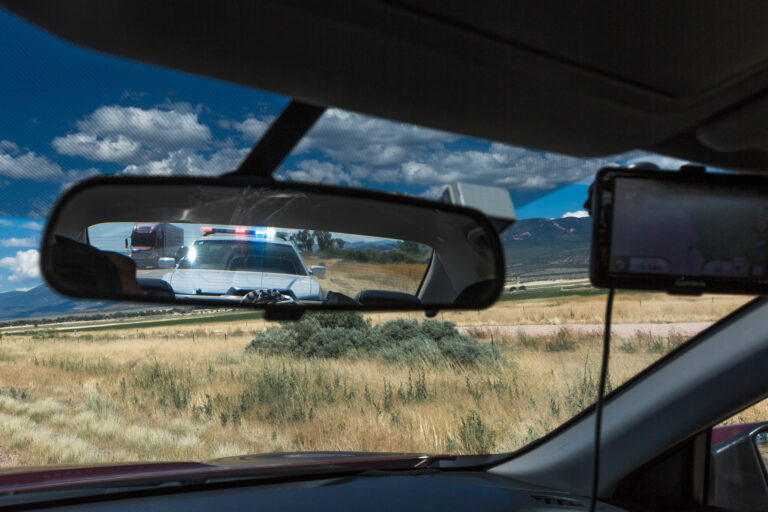
The reason for which you stop any vehicle is all important. You must never stop anyone; unless, you have a valid reason to do so.
~ Barry M. Baker Tweet
Detective Lieutenant Barry M. Baker (ret.) is a 32 year veteran of the Baltimore Police Department.

The police traffic stop is at the top of the list for the most dangerous activities in which a police officer can engage. It’s impossible to prepare you for a fraction of the circumstances you’ll encounter during police traffic stops. You must never forget that every one of them will be a potentially dangerous undertaking.
There were 48 police officers feloniously killed in 2019. Six (6) of those police officers were feloniously killed in the routine activity of a police traffic stop. During your academy training, this fact will be impressed upon you. The training will be designed to ensure your maximum protection, and you’ll do well to pay close attention. As a police officer, you’ll soon learn that perceived circumstances can instantly change into something totally unexpected. You’ll also learn that the police traffic stop is fertile ground for rapidly changing circumstances.
People are at Their Worst during a Police Traffic Stop
No matter their educational, financial, or social status, people are at their very worst when behind the wheel of an automobile. There will be occasions when you stop people who are very polite and cooperative. You can’t expect anyone to be pleased with the prospect of receiving a citation for a traffic violation. There are more than a few people out there who don’t realize that a nasty attitude serves no purpose.
If you’ve ever been pulled over by a police officer, you’re familiar with that queasy feeling you get in your stomach. You also know, with rare exception, why you’re the subject of a police traffic stop. Even though people know exactly why you’re stopping them, most will still ask the question, “Why am I being stopped?” I particularly love this one.
You stop a car for running through a red light. Before you can even get out of your car, the operator of the car you stopped is out and running toward you shouting, “I didn’t run that red light!” Yes…you’re going to run into some real winners and losers during a police traffic stop depending upon how you view their behavior.
Your Attitude Goes a Long Way
Your attitude has everything to do with how well or badly a police traffic stop will go for both you and the person stopped. The one thing you must never, never do is argue with the person. You’re in a position of ultimate power. There will never be any reason for you to engage in any conversation that is argumentative. Sarcasm is out of bounds as well. People will open themselves up for more than a few clever responses. You must resist the urge to subject a person to any kind of humiliation.
I stopped a man for running — really running — a stop sign. This guy was bad. He never stopped talking as he went from all the usual donut shop remarks to, “Why aren’t you out there arresting murderers instead of [expletive] with me?” It was obvious from the very beginning that he was trying to get me to argue with him. He didn’t stop his loud and abusive tone; until, I handed him the citation for his signature.
He was quiet as he read the citation while I explained to him that his signature was simply to verify his receipt of the citation, and it was not an admission of guilt. When I finished speaking, the man looked up at me and spoke. This time his tone was normal and subdued. He said, “You’re as bad as that state trooper who stopped me last month. You guys are so polite, it makes me sick.”
Have a nice day
I’ve always hated the phrase, “Have a nice day.” When you make a police traffic stop and issue a traffic citation to a person, you have literally ruined that person’s day. To me, saying, “Have a nice day” to a person you’ve just nailed with a citation is sarcastic and devoid of any sincerity. As I handed the stop sign runner his copy of the citation, I conveyed to him my standard parting phrase, “I hope the rest of your day goes better.” It worked pretty well on him. Instead of making a nasty remark or just ignoring me all together, he replied, “Yea…you too.”
Now…you’re going to run into some people who you’ll think just landed from another planet. Right from the very beginning they’ll question everything. “Why do you want to see my license, I didn’t do anything wrong,” or “I don’t have to show you my license.” Then, there’s the, “I’m not signing that ticket.” You really need to take the time to explain to these types that failure to follow your lawful commands will result in arrest. Some will take you to the point of you showing your handcuffs while others never get it; until, the judge gives them a quick education on the subject.
The Police Traffic Stop and Quotas
From time to time you’ll hear police traffic stops and citations come under the heading of “quotas.” I can truthfully say that during my career, I never had a supervisor require any specific number of traffic citations. The car stop is another story, but you can’t classify the car stop in the quota category. You may well have a supervisor who will require you to perform a minimum number of car stops — perhaps two — during your shift. The way people operate automobiles makes two car stops per shift a very easy task to accomplish.
The reason for which you stop any vehicle is all important. You must never stop anyone; unless, you have a valid reason to do so. When it comes to moving vehicles, you’d have to be blind not to observe a valid reason which can be as simple as an operator failing to use a turn signal or coming to a complete stop at a stop sign.
The Police Traffic Stop as an Investigative Tool
Let’s say you’re patrolling an area where there have been several reports of a man trying to entice small children to get into his car to help him look for his lost puppy. In one of the incidents, a sexual assault did occur. There’s been no good description beyond a white male operating a dark color car. As you’re sitting in your car just off the street near an elementary school, you see a car pass slowly in front of you. A few minutes later, you see the same car pass again in the opposite direction. Again, the car is moving slowing, and the operator is frequently glancing toward the sidewalk.
Ordinarily, the man’s behavior is no big deal. Perhaps he’s just looking for someone or even an address. However, the operator and the car do fit the description, limited as it is, of a possible child molester. The activity you’ve observed so far does not establish probable cause for you to make a police traffic stop. You simply get behind him and follow. Anyone’s discomfort increases the longer a police car dogs them. A person involved in criminal activity suffers an even greater level of discomfort. Once that person determines, rightly or wrongly, that he or she is the subject of your interest, that person will make a mistake.
Probable Cause to Stop
Once you’re behind this guy, he quickly changes his slow moving search mode, and he begins heading out of the area. You follow him for several blocks, and it’s obvious that he’s trying to do everything right including coming to complete stops at stop signs. This guy’s actually pretty good at not screwing up; until, he makes a left turn at an intersection. The street he turns into has a left turn lane, and he cuts his turn too short causing him to enter the left turn lane. He travels on the wrong side of the center dividing line. Oops!
You turn on your overhead lights, and your man quickly pulls over. When you approach the driver’s door, the man is already removing his license and registration from his wallet. The man is obviously nervous…that’s okay…but, he’s being just too friendly. He immediately acknowledges what he did wrong.
Puppy Collar
As he gushes on about his stupidity, you’re looking around the interior of the car. You notice a child safety seat in the back seat of the car. You also notice that the man does not wear a wedding band. Okay, no big deal. But…your next observation has more significance. On the floor of the front passenger side you see a dog leash. At the end of the leash is attached a small dog collar as in puppy collar.
If it turns out that this guy is indeed the suspect responsible for the sexual assault, your observation of that dog collar in plain view could be significant. If you’d stopped him on a hunch, that observation would be lost since you had no probable cause to stop the vehicle. But…the citation you issue for the traffic violation will clearly establish probable cause for the police traffic stop.
Stop Me!
Sometimes, a person might as well put a big sign in the back window saying, “Stop Me!” Car thieves are the best…or worst. If there were a true definition for acting guilty, these guys would be that definition. Car thieves are usually young, and they panic easily. You’ll know what I mean when one day you’ll stop behind a car at a traffic light. You’re not even thinking about making a police traffic stop. Suddenly, the doors will swing open, and several young men will jump from the car and run in different directions. You’ll then watch helplessly as the driverless car rolls into the intersection.
Related Content for Police Traffic Stop
Advertisements