It will occur without warning, and there won’t be any overt action prior to the main event.
~ Barry M. Baker Tweet

Detective Lieutenant Barry M. Baker (ret.) is a 32 year veteran of the Baltimore Police Department.

A police ambush can occur anytime, anywhere and under any circumstance. Your only defenses are vigilance, instincts and a touch of paranoia. Ambush is defined as lying in wait in a concealed position preceding an attack, but the definition expands regarding police. Soldiers patrolling a combat zone have a probable expectation of being ambushed, but police officers have no similar probable expectation.
Police officers are physically attacked on a continual basis, because it’s a natural result from dealing with difficult situations. You’ll frequently encounter potentially dangerous circumstances, but training and experience offer you a level of preparedness for violent responses. The police ambush is different. It will occur without warning, and there won’t be any overt action prior to the main event.
Is Luck a Factor?
Are some police officers just lucky? It would seem so. I and another officer responded to a residence for a burglary in progress. We encountered a young man on the premises, but our investigation produced no evidence of a burglary. The man was calm and cooperative, and he exhibited no unusual behavior that would arouse suspicion. He was polite but not overly polite. We had no reason to suspect that we would shortly become victims of a police ambush.
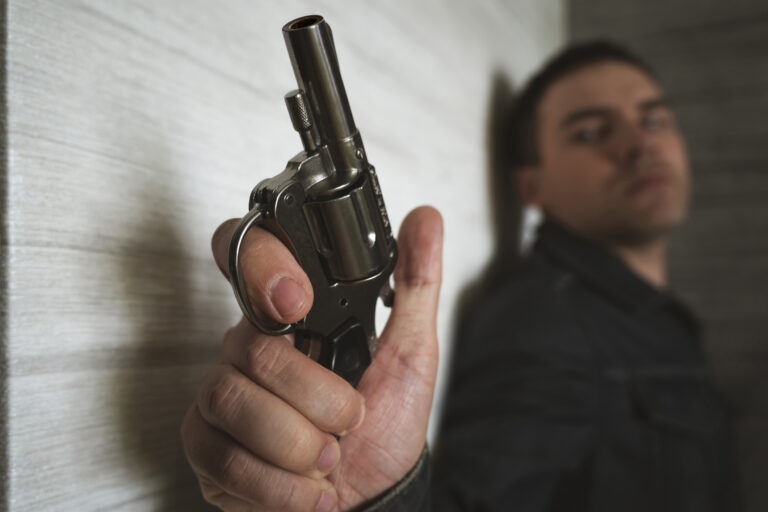
We did the usual stuff. I checked with 9-l-l for any additional information, and we ran a warrant check on the young man. He was seated on a couch as we completed our investigation and prepared to leave. We both turned away for only a couple of seconds, but it was enough time for the suspect to execute his police ambush. He retrieved a sawed-off rifle from beneath the couch, and he pulled the trigger on us. No shots were exchanged with the suspect, because his gun misfired. The suspect discarded the weapon even before we could bring our guns to bear.
What were the Odds?
When I flipped the couch upon which the suspect was seated, I found a mini arsenal. There were two fully loaded revolvers along with the rifle and boxes of ammunition. I wondered if the suspect intended to grab the rifle, or was it the first weapon to fill his grasp. There was another question. Out of three guns, what were the odds that he would choose the faulty one? For that matter, what were the odds that any of the three would be faulty? Maybe, it was just luck that we survived a police ambush without a scratch.
When would you be Most Vulnerable for a Police Ambush?
This isn’t a hard question to answer. Get into the head of the suspect, and ask yourself what circumstance you would desire for a police ambush. Like everyone else, you know that police officers wear protective body armor, so a head shot would be preferable. You would want the target seated in a confined space to prevent or impede escape and effective retaliation. It would help if the target’s engaged in an activity like writing a report or eating lunch. Do police cars come to mind?
Why Some Die - Police Ambush
New York City police officers Rafael Ramos and Wenjian Liu were sitting in their police car near a busy intersection in Brooklyn. The assassin simply walked up to the car’s passenger side window, and he began firing bullets into the officers. This police ambush made headlines all over the world, because this was about more than just two murdered cops.
The side stories abounded giving politicians and activists of every stripe the opportunity to weigh in with their comments. Except for being cops, Officers Ramos and Liu had nothing to do with all the reasons for their deaths. Some asked if this police ambush could have been prevented, because warnings were in the pipeline. The Baltimore County police in Maryland had warned the NYPD of the assassin’s journey to New York to kill cops.
There’s nothing wrong in asking why things happen and making efforts to prevent future events. When it comes to the police ambush or other senseless acts of murder, the reasons why are of little consolation. Your safety will always be your responsibility, because you’re the only one who will give it the attention it deserves.
A Universal Instruction
Omnipresence has always been a basic premise of uniform police patrol, because the visible presence of police does prevent crime. You’re going hear it often throughout your career as a patrol officer. How does omnipresence relate to the police ambush? When there’s a particular problem in your area of patrol, your supervisor will tell to increase omnipresence. The supervisor may suggest you write reports or eat your lunch in the thick of things – so to speak.
Vigilance is a trait to develop as a routine, and you should minimize the effect of any activity that distracts. Writing reports or eating lunch in your car is an activity that will affect your optimal level of vigilance. Any criminal contemplating a police ambush will be looking for an officer whose attention is diverted. I always chose locations off the street where my peripheral vision was unobstructed. I would be out of normal pedestrian traffic, so I could identify anyone approaching me. Additionally, I would exit my car to conduct any interaction with the person.
At the beginning of this post, I mentioned instincts and a touch of paranoia. You’ll develop both as your police career progresses. The trick is to develop voluminous portions of the first, and a small portion of the latter.
Related Content for Police Ambush
Advertisements