In some police departments, you'll see plainclothes officers in unmarked cars running around all over the place stopping cars by flashing lights...and badges.
~ Barry M. Baker Tweet
Detective Lieutenant Barry M. Baker (ret.) is a 32 year veteran of the Baltimore Police Department.

The unmarked police car is used for a variety of purposes including traffic stops. How they are purposed can become problematic. It’s not an uncommon sight to see police officers using unmarked police cars to stop people for committing traffic violations. State Police and Highway Patrol agencies sometimes use car models not normally associated with unmarked police cars. There’s no common standard used when it comes to the number or placement of emergency signal lighting on unmarked police cars.
For instance, one may employ a single blue and red flashing strobe light in the windshield while another will be lit up like a Christmas tree. You’ll see red, blue, or a combination of red and blue lights mounted all over the place. White strobe lights within the headlights may be flashing along with the rest of the light show.
The Police Impersonator and the Unmarked Police Car
From time to time you’ll hear or read about instances where motorists are being stopped by a man impersonating a police officer. Women are most often the victims of these police impersonators for obvious reasons. First, the police impersonator believes that a woman, rightly or wrongly, will be more submissive to his pretended authority. Secondly, and more ominously, the impersonator’s ultimate goal may be his intent to commit a sexual assault.
The police impersonator has no problem making his car look like an unmarked police car. The emergency lights mentioned above are readily available to anyone. Roof bar lights can be purchased; however, a bar light would be too easily noticed by a real police officer. A portable flashing light can be mounted on the car’s roof or dash with easy placement and removal.
Police Department Policies for the Use of Unmarked Police Cars
Some police departments discourage officers from stopping motorists using the unmarked police car even when the officer is in uniform. Some states don’t require motorists to present a driver’s license when an officer not in uniform makes a traffic stop.
Police departments used to be careful regulating use of the unmarked car; however, times do change. In some police departments, you’ll see plainclothes officers in unmarked cars stopping cars by flashing lights…and badges.
You're a Woman Alone – Stopped by an Unmarked Police Car
If I were a woman driving alone, particularly after dark, and I was signaled to stop by an unmarked police car, I think I might have some concerns. I’ve heard women voice concerns regarding safety when it’s not obvious that the signaling car is an unmarked police car.
The probability of being stopped by a harmless wanna be cop or worse is not that great, but your concern is still valid. Your personal safety should always be your paramount concern. If the time ever comes when you’re signaled to stop by an unmarked police car, and your instincts tell you something isn’t right, there are actions you can take short of immediately stopping.
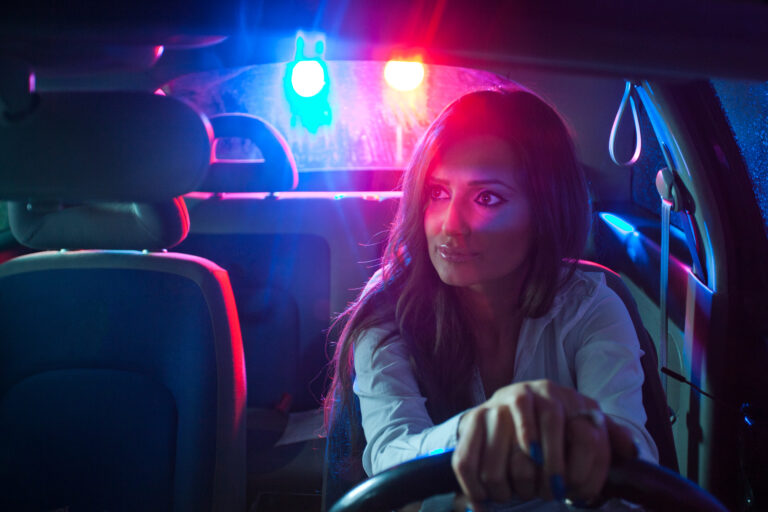
Let’s look at some examples. You’re driving on a remote stretch of highway when you notice a set of headlights approaching rapidly behind you. You glance into your mirror, and you see the car slow to your speed directly behind you. A dash mounted red or blue light begins flashing through the car’s windshield.
In this example, you immediately pull onto the shoulder of the highway and stop. You’re looking through your side view mirror as you watch the driver exit his car. The man begins walking toward you, and you notice that the man is not wearing any type of uniform. Your next action is simple. You put your car in drive and drive off.
You’ll Know You’ve Done the Right Thing
You check your rear view mirror, and you see tail lights instead of headlights. You know you’ve done the right thing. In the same example: This time, the driver of the car turns off his headlights and flashing light, before he exits his car. This is a really bad sign…don’t wait for him to even get out of his car. Just drive off.
Okay, let’s say that you drive away, or you decide to not immediately stop for some other reason. The unmarked police car continues to follow and signal with the emergency lights or even a siren. You should always remember that you could be issued a citation for not stopping or even arrested for attempting to elude a police officer. The eluding part, however, will not apply as long as you do not speed, turn off your lights or travel a circuitous route. Just travel in a straight line to an area where you’d feel more comfortable stopping.
If the area where you intend to stop is not that far away, there shouldn’t be any problem with your explanation to a police officer. However, let’s say you’re on a really dark stretch of highway, and the closest, well-lit public area is several miles ahead. If you have a cell phone, simply call 911 and describe your circumstance. The 911 operator should be able to rapidly verify that it is a police officer behind you. If that verification is made, you should immediately pull over.
The Police Impersonator does not want to Attract Attention
It’s not likely that a police impersonator would follow you for any distance. The longer he pursues, he’s simply going to get unwanted attention from other motorists. His biggest concern will be that he will attract the attention of a real police officer. So, if you look in your mirror only to see your pursuer going in another direction, you’ve again done the right thing.
This time, you’re taking your unmarked police car on the long route, and the unmarked car stays with you. You’ll likely find out pretty quickly that it’s a real police officer behind you when you observe another vehicle approaching from behind, or in front of you, with emergency lights flashing. Depending upon the area you’re in, you might see more than one.
Obviously, it’s now time to pull over. Once you’re stopped, turn on your interior light, lower your driver’s door window, place both your hands on top of your steering wheel, and wait for the police officer’s commands. Listen very closely and follow any command given exactly and without hesitation. Remember, your failure to stop has given the police officer cause for concern. You’ll have ample opportunity to explain your actions once the police officer has satisfied all of his or her safety concerns.
Clothes Do Not Always Make the Man
Some police impersonators will go to great lengths to look like a police officer. They’ll do their best to replicate uniforms as similar as possible to the police jurisdictions in which they’re operating.
A Maryland man was having success with his Maryland State Trooper fantasy; until, he graduated from stopping four wheeled vehicles with unmarked police car stopping an eighteen wheeler. The truck driver, who had experience interacting with Troopers, immediately recognized the obvious. The trucker defended himself with the phony cop’s own nightstick, and he held the impersonator for the arrival of real Maryland State Troopers.
Replicating a Uniform to go along with the Unmarked Police Car
As a rule…to most people, a uniform is a uniform. While the unmarked police car can be created by a simple light, replicating a uniform can be more difficult. If the impersonator makes a serious effort to replicate a uniform, he can acquire nearly everything he needs.
The one most difficult item to replicate will be the badge. He may be able to obtain a badge that looks similar in appearance to the real one for the particular jurisdiction, but real badges are hard to come by. Most police departments do a pretty good job of accountability when it comes to their badges.
It’s easy for you to familiarize yourself with the badges used by your local police department and surrounding jurisdictions. Every police department has a website where the badge is often prominently displayed. In some departments, the design and colors may vary depending upon rank. For example, in Baltimore, the design of the badge is the same for everyone. The only difference is in color with the badge being silver for police officer and sergeant. All ranks above sergeant are gold in color.
Just remember, your safety comes first. Whenever you’re stopped, remain in your car. Take a good look at the officer, and you should be able to observe if anything is amiss. If something about the uniform doesn’t seem right, assuming you’re familiar with that agency’s uniform, politely ask the officer to show you his departmental identification card. It may be an annoying request, but it’s not an unreasonable one. If he refuses, drive away. If he’s legitimate, there’ll soon be a marked police car on your tail.
You Can't Make Up this Stuff!
A high ranking police commander was driving home from work when a female driver cut in front of him nearly causing a collision. How many times has this happened to you? While it’s an aggravating experience, the smart thing to do is congratulate yourself on your alertness, and continue on your way.
This commander was no youngster, and he should have known better than to do what he was about to do. While he was neatly dressed in coat and tie, he was not in uniform. His unmarked police car was equipped with an array of red and blue emergency lights, and he, stupidly, used them.
Not being in uniform was bad enough, but he was no longer physically within his police jurisdiction. The female driver immediately heeded the commander’s signals to stop. Not only was she good at cutting off other drivers, she exhibited her habit of stopping short resulting in the commander’s car striking the rear of her car. The collision was very minor, but this was just the beginning of the commander’s problems.
What was in this Cop’s Mind?
I have no idea what was in this cop’s mind when he stopped this woman. As a commander of his rank, he had no citation book assigned to him. Had he at least been in his jurisdiction, he could have called for a police officer to issue a citation listing the commander as the witnessing officer… provided he hadn’t hit her car.
But, that wasn’t how things were, and this police officer rapidly went from enforcer to violator. The woman was no shrinking violet, and she demanded to see the commander’s driver’s license and registration. While the commander did identify himself, he — unbelievably — refused to present his driver’s license and vehicle registration to the woman.
This was Traffic 101. Whenever you’re involved in a traffic accident, no matter how minor, each driver must exchange license and registration documents for verification and information exchange.
Anyway…this encounter didn’t go well, and the commander ended up leaving the scene without properly exchanging information. The woman promptly called police. The police investigation ultimately concluded with the commander being issued a citation for leaving the scene of an accident…hit and run! The facts were indisputable, and the commander was guilty. The citation was bad enough, but after the story hit the news, the embarrassment to the commander, and his department, was far worse.
Police Officers not in Uniform
I’ve got a thing about police officers not in uniform stopping motorists. I never did it during my career, because I believe it’s a bad practice for what should be obvious reasons. I’ve instructed by wife to drive away from a stop if the man making the stop is not in uniform. If the man is a police officer and a reasonable person, he should understand. If he cites her, that’s fine too. I’ll simply make my explanation for the instruction to the traffic court judge.
There may come a time during your police career when you’ll be operating an unmarked police car. Just strictly adhere to your police department’s directive detailing what restrictions apply to the use an operation of unmarked police cars.
Related Content for Unmarked Police Car
Advertisements